



Back in January, while catching up on all of my must-watch films for our Odd Trilogies Best of 2023 episode, one of the films I watched ended with a black-and-white shot of light shining through leaves, accenting a chunk of text in the middle of the screen that said this:
“KOMOREBI” – The Japanese word for the shimmering of light and shadows that is created by leaves swaying in the wind. It only exists once, at that moment.
For over half a year, that description has stayed with me. There’s something about that natural, tranquil phenomenon that personally intrigues me, wondering how much that feeling of catching a fleeting yet beautiful moment can be transferred to other aspects of everyday life. Then my mind started to wander more: what would be the cinematic equivalent to that moment? When nearly every aspect of a film is planned or staged, is there such a thing as a moment of komorebi in cinema?
Absolutely. One of art’s greatest powers is giving an audience a moment that speaks to them in ways they never thought anyone else could understand; a feeling that they never realized other people had also felt. That feeling can be conveyed through specific brushstrokes in a painting, a singular line in a novel, a chord progression in a song, or even a facial expression in a comic. While komorebi describes a phenomenon in nature, I believe it can be easily translated to film. Anyone who has watched movies long enough has had at least one speak volumes to them. To me, a movie is truly great if there’s at least one scene that captures komorebi.
Now if we agree that “cinematic komorebi” can exist, what would be a good example of it? I don’t think you’d have to look any further than the film that introduced many (including myself) to that term: last year’s Perfect Days.
Perfect Days is a Wim Wenders film following Hirayama (Koji Yakusho), a man who spends his days cleaning toilets all throughout Tokyo. He mainly keeps to himself yet takes a few moments throughout his day to watch his surroundings, taking snapshots of trees and watching patrons that come through as he’s working. He wakes up every morning to the sound of an old woman sweeping outside his apartment, usually opening his eyes with a slight smile on his face. He’s a man with a consistent routine, but when others inadvertently uproot it, he’s more than willing to go with the flow and see where this sporadic change will take him. For most of the film, it is focusing on Hirayama’s cherishing of little moments that most people tend to miss as the days go on.
Now, before I describe my example of cinematic komorebi, I want to explain where my criteria comes from. In the phenomenon’s natural state, it focuses on when two elements—light and shadow—converge in an experience that is passing yet engrossing. In a cinematic sense, the easiest way to capture that is by focusing on its two most fundamental aspects: audio and video. Cinema, at its best, blends the visual with the auditory in a way that keeps you enamored with the screen, grabbing you emotionally with stunning camera angles and motifs in a score. So to really capture that phenomenon in an artistic sense, every element behind the scenes needs to be melding perfectly with what we’re seeing on the screen. There is one other aspect that is important but I’ll wait to reveal that until I get into the example.
(DISCLAIMER: From this point forward, I will be spoiling the latter half of Perfect Days to fully give context to my example. If you haven’t seen the film, I highly recommend it. It’s a perfect film in my book.)
In the latter half of the film, it reveals Hirayama’s complicated family dynamic and his fear of growing older. The last few days we see of Hirayama’s daily life see him deal with work troubles, a surprise reunion with his younger sister (along with a niece he clearly hasn’t seen in years), and chance encounters with strangers that challenge his own feelings of mortality. As the film rolls toward its finale, we see the smile that Hirayama welcomes every morning turn into a neutral expression. It wouldn’t be surprising to hear if many first-time viewers would be worried that his smile would never come back. Those worries disappear entirely in the film’s final scene.
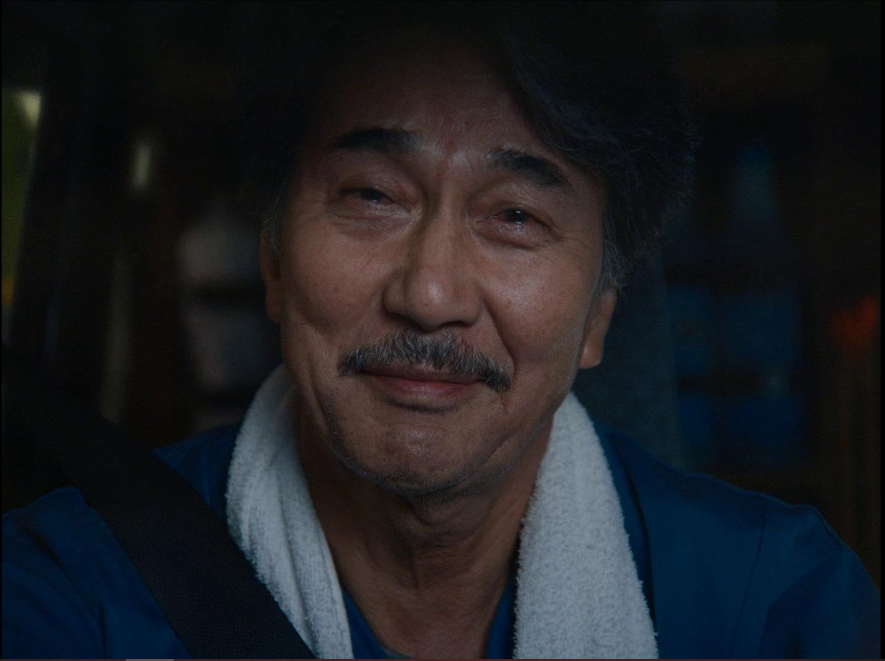
In the closing scene, Hirayama cries tears of sadness and joy as he drives to work to the tune of “Feeling Good” by Nina Simone. As Simone’s song strikes a chord with Hirayama’s internal conflict, the sun shines through the windshield as a smile hits his teary face. In this uncut moment, Hirayama looks directly into the camera, ready to take on what the day has in store for him. Regardless of his doubts, fears, and insecurities that plague him, Hirayama drives into the day with his head held high and a smile on his face.
From the slow dolly into the windshield to Koji Yakusho’s watery eyes piercing the screen as he looks head-on, there’s an easily missed perfection in how this scene captures the beauty of living for another day—as well as the sadness toward all the time that has passed us by. It’s a finale that beautifully depicts the blessing and curse of living: the freedom of believing we can do anything versus the reality that begs to differ. While I see this scene in an optimistic light, I can’t denounce anyone who sees it more as bittersweet. One of the best parts about a phenomenon like komorebi is that it is in the eye of the beholder.
Which brings me back to the third and final important aspect of komorebi: the viewer. This phenomenon would go undefined if it weren’t for a third party that saw the light and shadows mix in a way to create something truly profound in their eyes. So when it comes to cinematic komorebi, the final ingredient is the audience. To me, when I saw the ending of Perfect Days for the first time, I felt like a stranger had grabbed my lungs through the television and pulled the breath right out of me. At the time, during a profound amount of stress and uncertainty in my personal life, watching Hirayama smile through the tears as the sun hit his face gave me a second wind I never expected a film to give me.
Half a year later, the finale hit even harder the second time around. To be completely transparent, 2024 hasn’t exactly been the greatest year for me personally. A lot has happened that has made me look inward and made me be quite existential about the future in a way I never expected to be. At times, I have been genuinely scared as to what the future holds. That is until I think about this scene; the sun when it hits Hirayama’s smiling face. The reminder that tomorrow is another day. When that happens, it always leads me to take on the day with a smile on my face.
Some say that the best art hits us at the most unexpected times. In my head, that’s where cinematic komorebi shines at its brightest: where the marriage of visual and aural bring the viewer a surprising moment that’ll stay with them until the day they die. It’s the kind of moment that might even inspire them to take that leap towards a future they’ve always wanted. To me, those are the moments worth looking for. They can certainly be hard to come by. Regardless, Nina Simone says it best in the ending of Perfect Days: it’s a new dawn, a new day, and a new life.
And you know what? I’m feeling good.

Freelance writer out of Indianapolis. Co-host of Odd Trilogies podcast. Whether it's films or television, I'm always down to watch!